
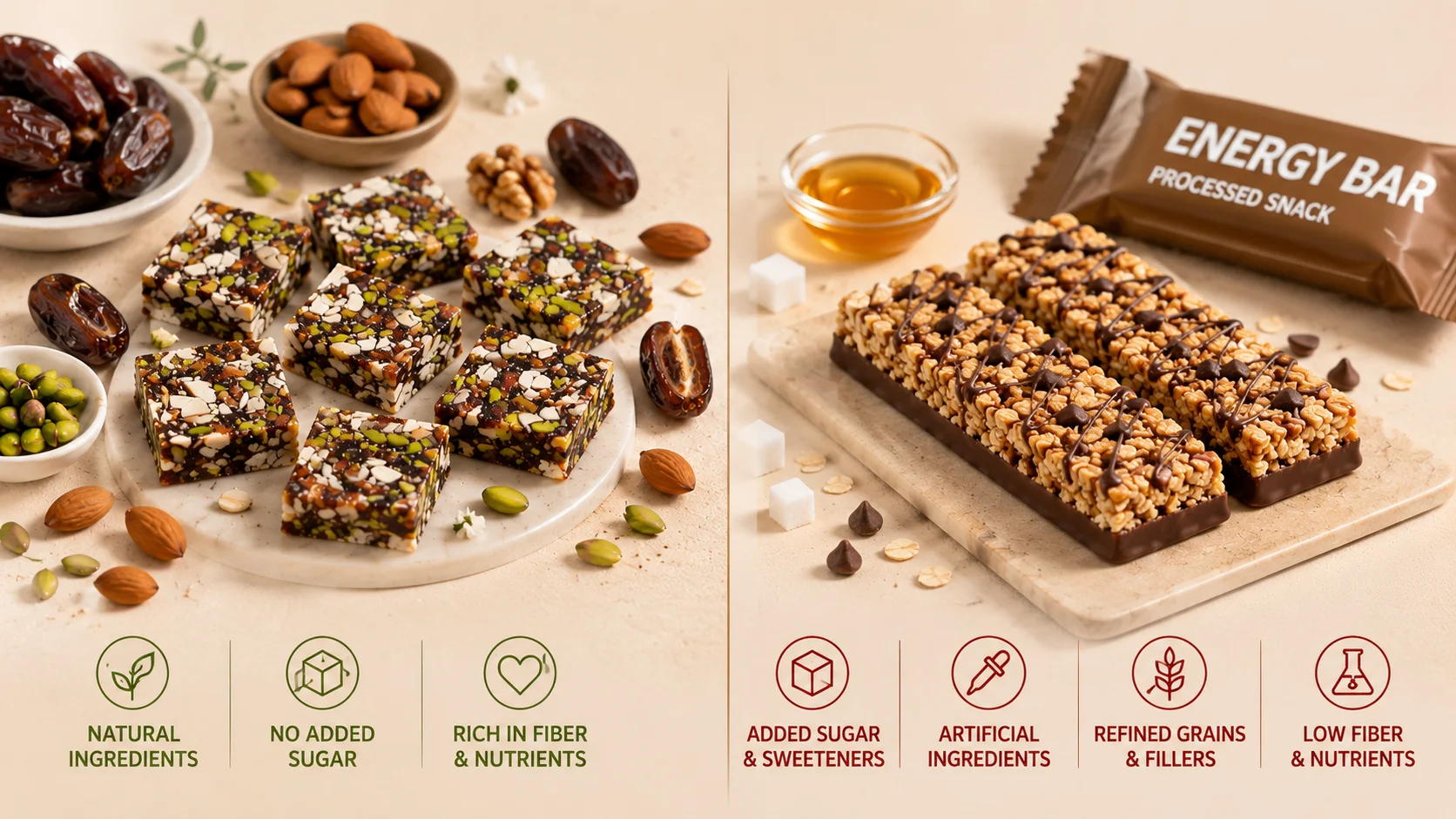
The modern Indian snack aisle has changed. Between office meetings, school runs, gym sessions and long commutes, people want convenient food without feeling that they are compromising on quality. This is where date bars, date and nut bars and regular energy bars often compete.
At first glance, they may look similar, but their nutritional profiles can be quite different. The key lies in the ingredients, source of sweetness, protein, fibre, level of processing and serving size. A well-made dates and dry fruit bar combines dates with nuts and dry fruits to create a convenient snack built around familiar ingredients.
When comparing the options, look beyond the name on the packet and consider:
- The main ingredients and how heavily the bar is processed
- Whether its sweetness comes mainly from dates or added sugar
- The amount of protein and fibre it provides
- The serving size and how well it fits your routine
The Real Difference Starts with the Ingredients
A date and nut bar typically has a simple foundation. Dates provide natural sweetness and carbohydrates, while almonds, cashews, pistachios, walnuts and other nuts can contribute protein, fibre, unsaturated fats and texture. Seeds and dry fruits may add further variety.
Regular energy bars are a much broader category. Some are made with oats, nuts, seeds, and fruit, while others may contain added sugar, syrups, chocolate, or other highly processed ingredients. Some are specifically formulated for sports nutrition, while others are simply designed as convenient snacks.
That is why the front of the package does not tell the whole story. Words such as “energy”, “fitness” or “natural” can describe how a product is positioned, but the ingredient list and nutrition panel show what you are actually eating.
Date & Nut Bars vs Regular Energy Bars
| What to compare | Date & Nut Bars | Regular Energy Bars |
| Main ingredients | Dates, nuts and dry fruits | Varies by product |
| Sweetness | Often comes primarily from dates or fruit | May include sugar, syrups or fruit |
| Protein | Naturally supplied by nuts and seeds | Can range from low to high |
| Fibre | Dates, nuts and seeds can contribute | Depends on formulation |
| Processing | Can have a relatively simple ingredient profile | Can range from simple to highly formulated |
| Everyday use | Convenient option for regular snacking | Often positioned around energy, fitness or performance |
A “healthy bar” does not have one fixed definition. A bar made with dates can still be high in calories, while an energy bar can have a well-balanced nutritional profile. The better choice depends on what is inside and why you are eating it.
Why Dates Make a Strong Base
Dates offer carbohydrates, naturally occurring sugars and dietary fibre, making them a versatile ingredient for snack bars. Their naturally soft, sticky texture also helps bind ingredients such as nuts and seeds together without always requiring additional ingredients to provide structure.
Because dates are fruit, they naturally contain sugar, even when no refined sugar has been added. However, using dates as the primary source of sweetness can reduce the need for refined sugar in a recipe.
Dates also have a familiar place in Indian food culture. The combination of khajoor and badam, for example, has long been enjoyed in Indian households. A modern date bar therefore does not feel completely unfamiliar. It simply presents traditional ingredients in a format that is easier to carry and portion.
What makes dates useful in snack bars?
- Natural sweetness: Dates provide sweetness while reducing the need to rely entirely on refined sugar.
- Carbohydrates: They provide carbohydrates that can contribute to everyday energy needs.
- Dietary fibre: Dates naturally contain fibre, adding nutritional value to the snack.
- Natural binding: Their soft texture helps bring nuts, seeds and other ingredients together.
- Familiar flavour: Dates complement ingredients commonly found in Indian snacks and sweets.
- Convenience: A date-based bar can be easily carried to work, the gym, or while travelling.
Why Nuts Make the Difference
Dates bring sweetness and carbohydrates to the combination. Nuts provide another nutritional dimension, contributing protein, fibre, unsaturated fats and various micronutrients. They also add crunch and texture, making the snack more satisfying than one based primarily on sweetness.
Almonds, cashews, walnuts and pistachios can each bring a slightly different taste and texture. Seeds can also complement a bar’s nutritional profile.
This is one reason date and nut bars can work well as everyday snacks. They are not necessarily designed as specialist sports nutrition, but they can provide a combination of nutrients that makes them more substantial than a snack based mainly on refined carbohydrates and added sweeteners.
What About Added Sugar?
This is one of the most important things to check when buying date bars.
Dates naturally contain sugars, so a date bar should not automatically be considered sugar-free simply because it contains no refined sugar. The more useful question is whether the product relies primarily on dates for sweetness or contains significant amounts of added sugar, syrups or other sweeteners.
Before buying, check the ingredient list and nutrition panel rather than relying only on claims made on the front of the package.
A simple four-point check
- Ingredients: Are dates, nuts, seeds or dry fruits among the main ingredients?
- Added sugar: Does the product contain sugar, glucose syrup or other added sweeteners?
- Protein and fibre: Do the amounts make sense for your reason for snacking?
- Serving size: How much does one serving actually contain?
This quick check can tell you considerably more than words such as “natural”, “energy” or “fitness” printed on the packaging.
Why They Fit Indian Snacking Habits
Indian snacking is changing, but the need for convenient food is hardly new. From an afternoon snack between meetings to something packed for school or carried during travel, portable food has always had a place in everyday routines.
A dates and dry fruit bar also fits naturally alongside familiar foods such as chikkis, laddus and other dry-fruit preparations. The difference is the format. A bar can be portioned individually, packed easily, and eaten without preparation.
For consumers looking for more considered snack choices, this creates an interesting middle ground. Eating better does not necessarily mean abandoning familiar flavours. Sometimes, it simply means choosing a more convenient format and paying closer attention to the ingredients.
Date Bars Before or After a Workout?
The right choice depends on the type and intensity of exercise and the nutritional needs of the individual. A date and nut bar can be useful before a workout because dates provide carbohydrates, while nuts contribute protein, fibre and unsaturated fats.
After exercise, however, protein may become a greater priority, particularly when the goal is recovery. In that situation, a bar specifically formulated with a higher protein content may be more suitable.
Choosing according to your routine
- Before exercise: A date bar can provide carbohydrates before physical activity.
- Longer workouts: Consider the carbohydrate content and serving size according to the duration and intensity of exercise.
- After exercise: Look for adequate protein when recovery is the main priority.
- Everyday fitness: A date and nut bar can be a convenient option between meals or when you need something to bridge the gap until your next proper meal.
The important point is not to choose a bar simply because the packaging says “energy” or “protein”. Look at the nutrition profile and match it to what you actually need.
The Healthier Choice Depends on the Formulation
A well-made date and nut bar can be a smart everyday snack when it is built around dates, nuts, seeds, and dry fruits, with limited added sugar. Dates provide natural sweetness and carbohydrates, while nuts add protein, fibre and unsaturated fats.
However, not every date bar is automatically healthier, just as not every energy bar is highly processed. The best choice comes down to the ingredients, nutrition profile and serving size.
The Final Bite
Date and nut bars combine familiar Indian ingredients with everyday convenience. They offer a simple way to enjoy dates, nuts, and dry fruits in a portable format.
That is the idea behind Healthy Belly, whose fruit and nut mini bars bring these familiar ingredients together for convenient snacking.
When choosing your next bar, look beyond the “energy” label. Check the ingredients, compare the nutrition and choose what fits your routine.
Frequently Asked Questions
1. Are date and nut bars healthier than regular energy bars?
They can be a better everyday choice when they are made mainly with dates, nuts, seeds, and dry fruits and contain limited added sugar. However, the specific formulation matters, so always compare the ingredient list and nutrition panel.
- Look for dates and nuts among the main ingredients.
- Compare added sugar, protein and fibre.
- Choose date bars according to your dietary needs.
2. Are date bars good for energy?
Yes. Dates contain carbohydrates and naturally occurring sugars, making them a convenient source of food-based energy. Nuts can add protein, fibre and unsaturated fats.
- Dates provide carbohydrates.
- Date and nut bars combine fruit with nuts.
- Keep serving size in mind.
3. Do date and nut bars contain added sugar?
It depends on the product. Some bars rely primarily on dates for sweetness, while others may contain sugar, syrups or additional sweeteners. The ingredient list is the best way to check.
- Look for sugar and syrups in the ingredients.
- Check the added-sugar information where available.
- Do not assume every date bar is free from added sweeteners.
4. Are dates and dry fruit bars good for weight loss?
A dates and dry fruit bar can fit into a balanced diet, but it is not automatically a weight-loss food. Dates and nuts are nutrient-dense and can also be calorie-dense, so portion size remains important.
- Choose a sensible serving.
- Look for a useful combination of fibre and nuts.
- Compare the overall nutrition rather than relying on the word “healthy”.
5. Which is better before a workout, a date bar or an energy bar?
It depends on the workout and the formulation of the bar. Date bars can provide carbohydrates before exercise, while specialised energy bars may be designed for particular training requirements.
- Consider the type and duration of exercise.
- Check carbohydrate and protein content.
- Date and nut bars can work well for everyday pre-workout snacking.